Wondering how a hygrometer tells you the humidity in the air? It works by detecting water vapor—either through a mechanical method, like a strand of human hair that moves with humidity, or an electronic sensor that changes capacitance.
Both types need calibration to keep readings accurate. Keep reading to see which one fits your needs best.
How a Hygrometer Measures Humidity (And Why It Matters)
A hygrometer measures humidity by detecting the water vapor in the air and expressing it as relative humidity (RH), a percentage indicating how close the air is to saturation. It tracks humidity fluctuations by comparing moisture levels against a reference point, often converting these measurements into a readable format. Temperature significantly impacts these readings because warm air can hold more vapor, meaning the same amount of moisture results in different RH levels at varying temperatures. To obtain accurate data, you should calibrate your hygrometer regularly, testing it against a known reference at set points like 30% or 70% RH and allowing the device to stabilize. Without proper calibration, sensor drift can compromise your readings, leading to unreliable humidity measurements. For water quality testing, you might also need a separate device that uses electrochemical sensors to measure pH levels, which is a different but equally important measurement. Monitoring humidity is crucial for preventing mold growth, protecting wooden structures, and maintaining a safe and comfortable environment. For long-term reliability, consider that the sensor drift can degrade accuracy similarly to how exhaust fans may lose efficiency over time. For gardens and plant care, a similar approach using a DIY soil pH test kit can help you measure and adjust soil acidity for healthier growth.

INACCURATE HYGROMETER READINGS PUT PREMIUM CIGARS AT RISK. Precisely calibrate digital and analog hygrometer and humidity sensors, so they give accurate relative humidity (RH) readings of what’s going on inside a humidor

✅【STOP GUESSING YOUR HUMIDITY】This professional 6-pack 75% RH humidity control pack uses a precision salt solution to create a controlled 75% RH reference environment, allowing you to verify digital and analog hygrometers before trusting them inside your humidor or storage space. An uncalibrated hygrometer can be off by 5–10% RH, leading to moldy cigars, dried-out wrappers, cracked wooden instruments, stale tea leaves, or damaged collectibles.[Note: Hygrometer is not included in the package]

1-【Widely Application】The digital LCD monitor can be used in home, office, garage, schools, hotels, laboratories, kindergartens, aquaculture, instrument workshop, warehouse, reptile tank terrarium, aquarium, hermit crab habitat, and other places where temperature/humidity measurement is required.
Mechanical vs. Electronic Hygrometers: Two Ways to Detect Moisture
Mechanical hygrometers rely on a material that physically expands or contracts with changes in humidity, causing the dial to move. They do not need batteries, which makes them ideal for simple, low-maintenance monitoring. Electronic hygrometers, on the other hand, use sensors that detect moisture levels and convert these changes into electrical signals. They require batteries or external power sources for operation. Your choice between the two often depends on your setup: mechanical units offer straightforward, battery-free use, while electronic models provide consistent digital readings with powered sensors. For gardeners using seedling trays, a mechanical hygrometer can reliably monitor humidity without added power needs. Understanding the uses and buying tips for each type can help you select the right tool. Calibration with salt tests is a simple method to verify both types.
Accuracy is a key difference. Electronic hygrometers typically achieve an accuracy of about ±2–3% relative humidity (RH), whereas mechanical dials often have a wider tolerance, around ±5% or more. Both types need regular calibration; mechanical units usually require manual adjustments, while some digital models include automatic or built-in calibration features. Electronic sensors generally respond faster, detecting humidity changes within seconds, while mechanical devices move more slowly, sometimes taking minutes to reflect humidity swings. For precision tasks such as laboratory work or HVAC control, electronic hygrometers are preferred. For basic monitoring and low-cost applications, a mechanical dial can be sufficient.
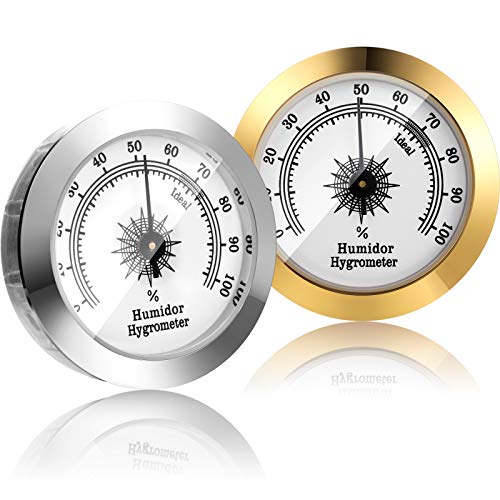
Package information: you will get 2 pieces hygrometer in classic color; The hygrometer is about 2 inches in diameter, compact size that is easy to take

2-in-1 Accurate Monitoring: This dual-function gauge measures temperature from -40°F to 140°F and humidity between 0% and 100% RH, providing steady precise readings for indoor and outdoor environmental tracking.

NO for battery NEEDED: Mechanical analog design works reliably in cold weather without draining, eliminating the need for frequent for battery replacements
What Happens Inside a Mechanical Hygrometer (No Batteries Needed)
Inside a mechanical hygrometer, a bundle of organic material such as human hair acts as the sensing element. These materials absorb moisture from the air, causing them to expand and contract. This mechanical response is key: as humidity increases, the hair lengthens; as it decreases, it shortens.
A spring keeps the hair taut, ensuring that even small changes in moisture transfer force to a lever system. These levers amplify the microscopic movement, resulting in the visible swing of a pointer across a calibrated dial. Because this process relies solely on physical reactions to humidity, no batteries or electronics are needed. The dial’s scale then translates the hair’s expansion into a relative humidity percentage, providing a continuous, straightforward reading.
How Electronic Sensors Turn Humidity Into a Number
Electronic sensors convert humidity into a measurable electrical signal by detecting changes in capacitance. They use a moisture-absorbing polymer whose dielectric properties shift as water vapor enters, causing a capacitance increase—typically around 0.2 to 0.5 picofarads per 1% relative humidity (RH). Since these tiny shifts are difficult to read directly, on-chip conditioning circuits translate the capacitance change into a stable voltage or frequency signal that can be processed further. For example, in a grow setup using mist sprayers, the sensor must withstand high moisture without compromising its capacitive readings. To maintain sensor reliability, you can apply sterilization techniques that prevent microbial growth on the sensor surface. Unlike flexible ducting, metal ducting offers a longer lifespan and greater structural integrity in high-moisture environments.
Calibration aligns raw electrical measurements with actual humidity levels. Manufacturers establish reference points and sensitivity calculations to map capacitance values to specific RH percentages, then adjust each sensor during factory trimming for accuracy. Modern sensors often incorporate digital conversion stages that output a ready-to-read humidity value over a data bus, with an accuracy typically around plus or minus 4% RH. Temperature compensation is also essential, as it adjusts measurements to account for temperature variations, ensuring the displayed RH is precise and trustworthy rather than just raw capacitance data.

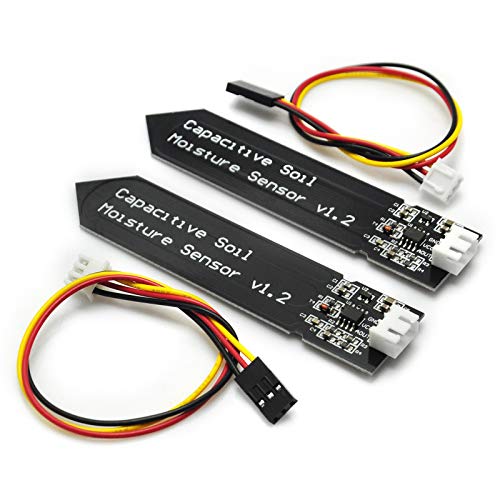
【Version】This capacitive analog soil moisture sensor is V1.2

When You Need Exact Readings: Wet-Bulb and Dew-Point Methods
When the exact moisture content of the air is critical, relying on a single sensor is not enough. Instead, you use wet-bulb and dew-point methods because they provide precise measurements rooted in thermodynamics. A sling psychrometer employs a wetted wick; as air flows over the bulb, evaporation cools it. Spinning the device improves airflow and stabilizes the reading until successive measurements match, giving you the wet-bulb temperature. Combining this with a dry-bulb temperature allows you to determine humidity accurately through psychrometric equations, which include corrections for station pressure. For direct dew-point measurement, you cool a surface until condensation forms; the temperature at which this occurs is the dew point, revealing the water vapor content without interference from other variables. Similarly, high-quality LED grow lights provide the precise spectrum needed for optimal bonsai health.
Historical advancements in psychrometry established these thermodynamic techniques as standard in meteorology and HVAC. When calibrating such instruments, you ensure stable airflow, use clean distilled water, and take rapid readings—this minimizes transient errors. A similar principle applies when calibrating a pH meter, as you must also use clean solutions and take stable, rapid readings to achieve accuracy. Relying on the relationships between temperature, humidity, and vapor pressure guarantees more trustworthy results than single-sensor approximations. To further ensure measurement integrity, you can confirm soil conditions by testing the soil pH to cross-check environmental factors for precise plant care.

Complete Classroom Kit: The Eisco Sling Psychrometer Classroom Kit provides a comprehensive 15-pack sling psychrometer kit, ensuring each student has their own equipment. This makes it ideal for science classrooms needing class-size coverage

Measure relative humidity with weather bureau-type wet and dry bulb thermometers
COMPLETE KIT || The 7-piece Sling Psychrometer Kit contains: (1) dry bulb thermometer (6.5"L), (1) wet bulb thermometer (6.5"L), (1) wooden handle (5"), (1) cloth sleeve, (1) screw, (2) rubber bands, (1) instruction guide
Which Hygrometer Should You Choose for Your Needs?
For most home and general use, a digital capacitive hygrometer with an accuracy of ±2–3% RH is the best choice. These models display readings clearly on an LCD or LED screen, making it simple to interpret the numbers quickly. Manual sensor calibration is a key feature, allowing you to recalibrate the device after months of use to maintain its accuracy. This is particularly helpful since sensors can drift over time. Analog hygrometers are an alternative if you only need rough checks and do not mind a higher error margin of around ±5% RH. They operate without batteries and are simple but less precise. For storage areas or non-critical spaces, cheaper resistive hygrometers can be sufficient, although their sensors tend to lose calibration faster, especially at humidity levels above 70%. If you are using a DIY net pot setup, ensuring the airflow around root zones is adequate can prevent excessive moisture buildup that skews readings. Ultimately, opting for a hygrometer with a capacitive sensor and manual calibration ensures better long-term reliability and consistent measurements. For example, when storing prepared coco coir, maintaining proper humidity is critical to prevent mold growth. Additionally, if you are using a growing medium like perlite, its neutral pH level ensures it will not alter the moisture readings or affect plant health.

Order is for 1 Unit | Color: Gold

1-【Widely Application】The digital LCD monitor can be used in home, office, garage, schools, hotels, laboratories, kindergartens, aquaculture, instrument workshop, warehouse, reptile tank terrarium, aquarium, hermit crab habitat, and other places where temperature/humidity measurement is required.

Convenient Design: Delicate size, portable, and light